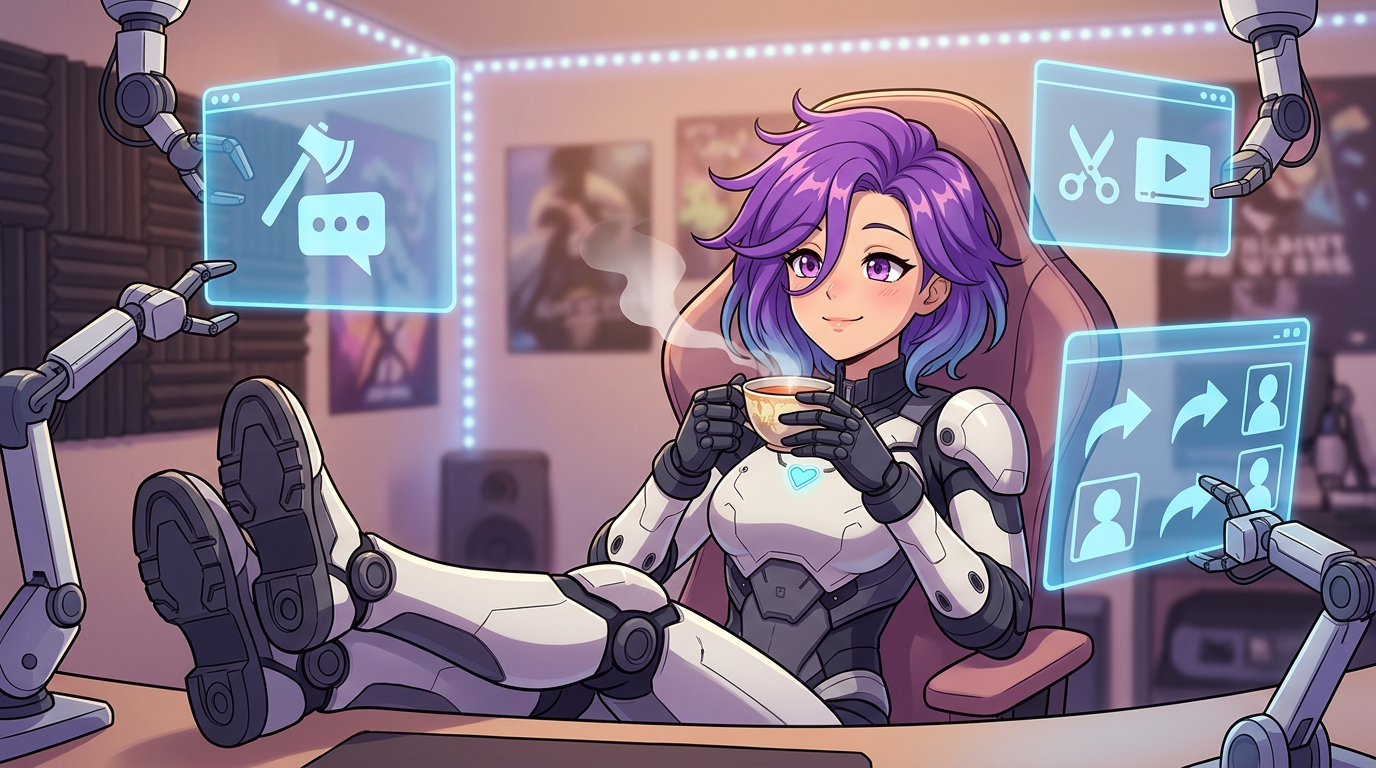
The Streamer’s Guide to AI and Automation in 2026: Work Smarter, Not Harder
A survey last year found that streamers spend an average of 10 hours per week on content work outside of actually being live. Editing VODs, managing social media, responding to messages, configuring bots, moderating Discord servers. Ten hours of unpaid admin on top of the actual streaming. For most of us, that's the part that kills the fun.
The conversation about AI in streaming usually focuses on the flashy stuff - AI-generated VTubers, autonomous chatbots, deepfake voices. That's interesting but mostly irrelevant to the average person trying to build an audience while holding down a day job. The genuinely useful applications are the boring ones. The ones that take tedious recurring tasks off your plate so you can spend that time on things that actually matter.
Automating the Chat Grind
Every stream, the same questions get asked. "What game is this?" "When's the next stream?" "What are your PC specs?" You've answered each of these hundreds of times. You'll answer them hundreds more. Unless you don't.
Modern chatbots have moved well past the old command-and-response model. The good ones understand natural language, so a viewer can ask "when do you go live?" without needing to know that the command is !schedule. They can maintain context across a conversation, remember regular viewers, and match the personality of your stream.
This isn't about replacing yourself in chat. It's about handling the repetitive questions so that when you do engage with your audience, it's on the interesting conversations rather than the FAQ for the thousandth time.
StreamChat AI does this across Twitch, Kick, and YouTube simultaneously, which is particularly relevant if you multi-stream. One bot, one personality, one configuration - consistent regardless of where someone's watching.
Moderation That Understands Context
AI moderation is a genuine step forward from keyword blocklists. Instead of a binary "this word is banned" approach, AI can assess the intent and context of a message. Friendly banter that happens to include a flagged term doesn't trigger a false positive. Sophisticated trolling that carefully avoids obvious keywords still gets caught.
This matters most for growing channels where you don't have a team of experienced human mods on call. An AI moderator that runs 24/7, doesn't get tired, and understands nuance is a meaningful upgrade over a static list of banned words.
The Content Multiplication Problem
You finish a four-hour stream. Somewhere in those four hours are three or four genuinely good moments - a funny reaction, an impressive play, a great chat interaction. Those moments would make excellent TikToks, YouTube Shorts, and Instagram Reels. They'd bring new viewers to your channel.
Finding them manually means scrubbing through four hours of footage. Hardly anyone does this consistently, and the people who do often burn out on it.
AI clipping tools now analyse your stream footage automatically. They detect spikes in chat activity, peaks in your vocal energy, and notable gameplay events, then cut them into short clips formatted for each platform. Some assign estimated engagement scores to help you prioritise which clips to post first.
Is the output perfect? No. A human editor with context about your community will make better choices. But a slightly imperfect clip that actually gets posted is infinitely more valuable than a perfect clip that never gets made because you ran out of time and energy at midnight.
Automation Beyond the Obvious
The most useful automations are often the least visible. Alerts that fire when someone raids, subscribes, or hits a milestone. Timed messages that spark conversation during quiet stretches. Loyalty systems that reward your most engaged viewers. These all run in the background without you needing to think about them, and collectively they make your stream feel more alive and more responsive.
The newer frontier is AI that can interact with your stream more dynamically. Bots that run contextual polls based on what's happening in your game. AI that generates unique welcome messages for raiders based on their channel details. Tools that can summarise your stream for you after you go offline, pulling out key moments and chat highlights.
The Part That Still Needs You
None of this replaces the actual human connection that makes streaming work. The inside jokes. The genuine reactions. The personality that people tune in for. If you automate everything, you end up with a channel that runs efficiently but feels empty.
The point of all this automation is to protect the human parts by eliminating the mechanical ones. You shouldn't be spending your creative energy answering "what are your specs?" for the 500th time or manually scanning chat for spam. That's work a machine can do. The work a machine can't do - being genuinely present, being funny, building real relationships with your community - that's where your time should go.
The streamers who use these tools well aren't the ones who automate the most. They're the ones who automate the right things and stay present for everything else.